



Dealing With Emotional Overload
Taking charge of your emotions can be a challenging process. For many people, emotions may cause overwhelming thoughts and feelings and make it difficult to continue daily tasks. However, many coping mechanisms and tools exist for dealing with emotional overload. Discover what emotional overload means, some signs you might be feeling overwhelmed and steps to manage the feelings.
What is emotional overload?
Emotional overload is the feeling of being overwhelmed by extreme or intense emotions. Often this emotional upheaval can cause challenges in daily life, such as problems performing tasks or a reduced ability to think and act rationally. When your emotions become hard to manage and interfere with your day, you may be experiencing emotional overload.
Stress is a common factor in emotional overload. Stressful tasks or situations can trigger an emotional response that may become overwhelming. Other factors may include past or present trauma and relationship issues with friends, family or romantic partners.
Seeing a therapist or counselor can be helpful for those who feel prolonged emotional overload. Mental health professionals can recognize signs of emotional overload and help you handle and cope with triggers or specific feelings. If you feel any emotion that overwhelms you, it is better to deal with it immediately than let it affect your mental or physical health.
Prolonged emotional overload can lead to many side effects. For example, those with overwhelming feelings may experience work or school trouble, conflicts in important relationships, increased substance abuse, physical outbursts, depression, anxiety, insomnia, fatigue or muscle pain. Handling emotions can help you improve your relationships while caring for your mind and body.
Signs and symptoms of emotional overload
Many stressors in your life, whether social, physical or emotional, may contribute to emotional overload. Some common signs of emotional overload include the following:
- Big reactions: You might react to small situations with big emotions.
- Physical illness: Emotional overload can cause physical illness or pain, such as headaches and migraine attacks.
- Fatigue: Strong emotions can be physically exhausting, leading to chronic or prolonged fatigue.
- Trouble focusing: Feeling overwhelmed makes it hard to focus on basic or daily tasks.
- Relationship issues: Emotional overload can cause problems with friends, families and partners.
- Influenced perceptions: Overload may cause sadness even during happy occasions, like weddings or parties.
- Trouble eating or drinking: Emotional stress can cause problems with appetite.
- Loss of interest: You might lose interest in activities or hobbies you love.
- Feeling guilty or hopeless: Emotional overload can cause guilt for your emotions or hopelessness about your situation.
Mental symptoms
When experiencing emotional overload, you might feel debilitated and unable to complete tasks or hobbies. Emotions can be mentally exhausting, leading to other symptoms in your mind and brain. Here are some emotional overload symptoms you might experience mentally:
- Anxiety: Emotional overload can cause stress and anxiety during your day.
- Anger: You might experience sudden anger or irritability, fear or guilt.
- Trouble focusing and completing tasks: Emotional overload can reduce your ability to focus or feel energized to complete tasks.
- Panic attacks: Panic attacks may result from increased stress and anxiety.
- Depression: Emotional overload can cause mental fatigue and depressive symptoms.
Physical symptoms
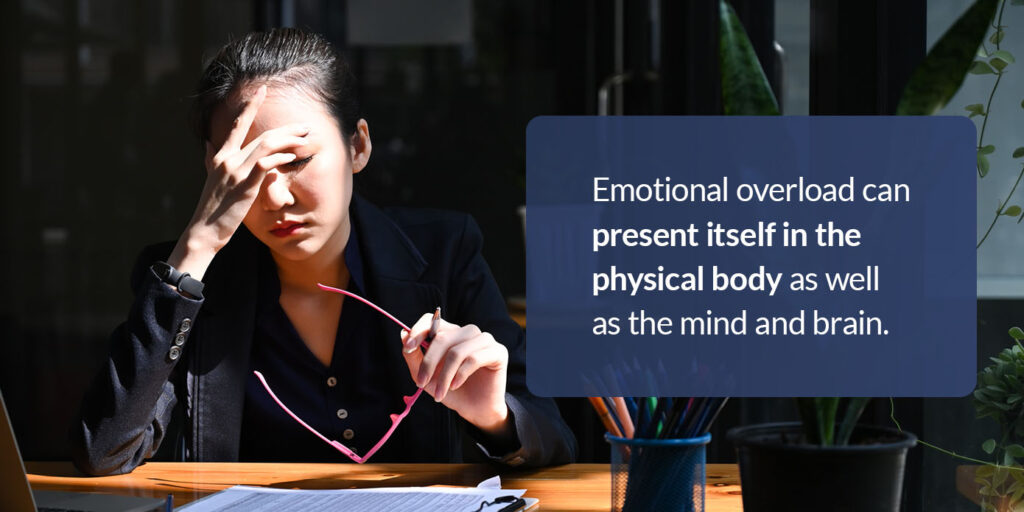
Emotional overload can present itself in the physical body as well as the mind and brain. Here are some physical symptoms of feeling overwhelmed:
- Heart rate: Your heart rate may increase and cause a racing or beating heart.
- Blood pressure: Blood pressure can rise and cause other physical issues.
- Muscle pain: You might experience tension and pain in the neck, shoulders, back or leg muscles.
- Headaches: Overwhelming feelings can lead to headaches and migraine attacks.
- Stomach problems: Emotional overload may cause stomachaches, digestion issues or bowel pains.
- Heartburn: Emotional overload can cause painful heartburn in the chest and throat.
- Fatigue: Your body might become exhausted.
- Insomnia: You have trouble sleeping at night.
- Weak immune system: Emotional overload can weaken the immune system and lead to other health issues.
How to handle emotional overload
Learning to cope with your emotional overload can be a significant step towards improved physical and mental symptoms. Here are five tips for handling emotional overload.
1. Go to therapy
Therapy can help you recognize signs and symptoms of overload, identify triggers and deal with challenging emotions. A mental health professional has the training and tools necessary to help you understand the root issue of your feelings while addressing what might be stressful in your current lifestyle or schedule.
Once you see a therapist, dealing with your emotional overload should become more manageable. They can give you coping skills so you have the right emotional management tools.
2. Observe and track triggers
Try tracking and observing your stress triggers. Triggers may be situations, people or tasks that make you feel overwhelmed and anxious. By observing and describing each emotion as you experience it, you can understand your cycle of emotions and what situations or people to avoid.
3. Reframe thoughts
Reframing your thoughts can help you cope with overwhelming feelings. If you experience an event or situation that causes stress, anxiety, depression or anger, consider stepping back for a moment and looking at your reaction. Ask yourself: "Why am I thinking this way?" Try to recognize the root issue. Remember that emotions are self-created, and you can break the cycle of stress or anger by thinking alternative thoughts. Try to see the situation differently to reduce your overwhelming response.
4. Be aware of vulnerabilities
You might be more likely to react with high emotions in some situations. For example, are you hungry, angry, tired or lonely? These situations might make you vulnerable to overwhelming emotional responses. By stepping back and determining your vulnerabilities, you can react less impulsively and engage in self-care.
5. Use coping methods and distractions
Coping methods and distractions can help you deal with emotional overload. Coping skills can help you identify triggers and learn what enables you to deal with certain feelings.
Distractions are another great way to decrease overwhelming feelings. Try participating in hobbies or activities, such as painting, playing music, seeing a friend or volunteering. You can also plan self-care activities, such as a bubble bath with candles or a personal massage and spa day.




Migraines triggered by overwhelming stress
Emotional overload and overwhelming feelings of stress can lead to a stress-induced headache or migraine. If you begin to notice signs of stress in your body, that may be a sign a migraine attack is about to start. By paying attention to your body’s symptoms and recognizing triggers, you can better prepare for or reduce the chance of migraine attacks.
Migraine attacks can be triggered by symptoms of stress, such as a racing heart, depression, anxiety, heavy chest, panic attacks and fatigue.
If you experience migraine attacks often due to stress, it may be time to re-examine your migraine treatment toolkit and try some other approaches. CEFALY Technology offers a wearable migraine treatment device to help reduce migraine pain and prevent future attacks.
Pruebe CEFALY hoy

The CEFALY device is clinically proven to relieve and prevent migraine. Following a 60-minute ACUTE treatment session with CEFALY, users in one study saw an average 59% reduction in migraine pain intensity. Buy CEFALY today!




Últimas publicaciones

La guía esencial de dispositivos médicos para la migraña
CEFALY is an FDA-cleared medical device that targets the main pathway for migraine pain: the trigeminal nerve (the…

“CEFALY Gave Me My Life Back”: Camille’s Search for a Drug-Free Migraine Treatment
I've lived with migraine since my second pregnancy with my daughter. That pregnancy marked the beginning of my…
What Patients Need to Know About Episodic Migraine vs. Chronic Migraine
While official definitions classify episodic migraine as fewer than 15 headache days per month and chronic migraine as…